When Prayers Seem Unanswered: How to Keep Faith During Cancer
There are few questions more tender than this one:
What do I do when I have prayed for healing, but God does not seem to be answering?
For someone walking through cancer, or loving someone who is, this question is not theoretical. It can rise in the quiet after an appointment, in the waiting between scans, in the exhaustion of treatment, or in the ache of watching someone you love suffer.
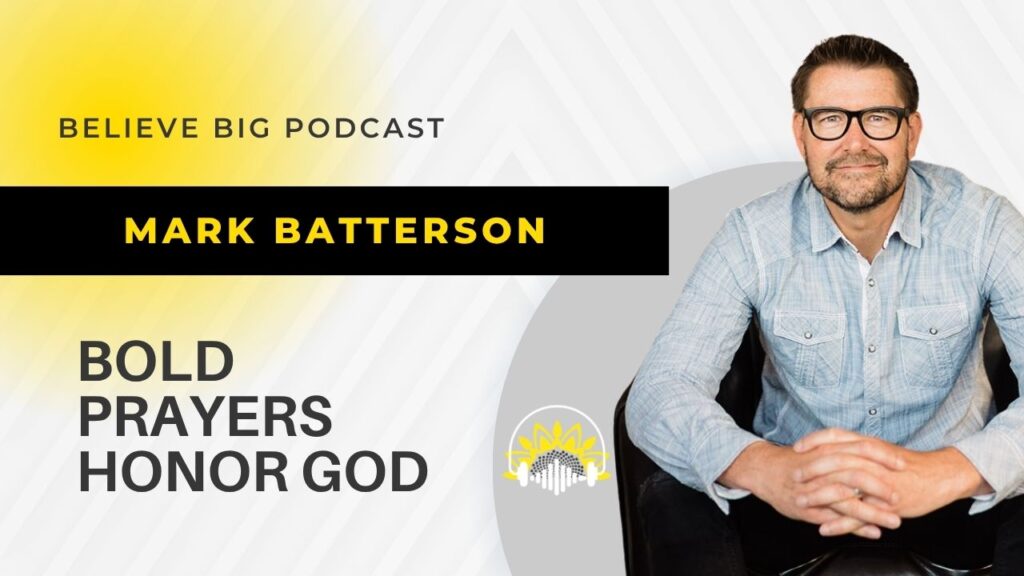
In this Believe Big Podcast Summer Replay episode, Pastor and author Mark Batterson joins Ivelisse Page for an honest and hope-filled conversation about bold prayer, unanswered prayers, healing, caregiving, and trusting God when the outcome is uncertain.
Mark is known for his powerful reminder that bold prayers honor God, and God honors bold prayers. But this conversation goes deeper than simply praying bigger. It invites us to keep praying, keep trusting, and keep taking the next faithful step, even when the road ahead is not clear.
Bold prayer does not mean pretending it is not hard
When Ivelisse asks Mark what he would say to someone who has been praying for healing and feels like God is not answering, Mark does not offer a quick or shallow response.
He acknowledges that it is a hard question. Pain, sickness, death, disappointment, and suffering are real. Faith does not require us to deny that.
That matters.
Sometimes Christians can feel pressure to sound strong when they are actually scared. Or to speak with certainty when they are carrying deep questions. But bold prayer is not pretending. Bold prayer is bringing the whole truth to God, the fear, the hope, the confusion, the tears, and the desire for healing.
God is not offended by honest prayers.
A cancer diagnosis can shake the ground beneath a family. It can raise questions about the future, treatment decisions, finances, relationships, and faith. In those moments, prayer may not sound polished. It may simply sound like:
“God, help me.”
“God, heal me.”
“God, show us the next step.”
“God, I’m scared.”
“God, I trust You, but I don’t understand.”
Those prayers matter.
Keep praying for miracles
Mark shares openly in the episode about praying for healing from asthma for decades. After 40 years of asthma, he experienced healing in 2016 and has not used an inhaler since.
That testimony is powerful, not because every healing story looks the same, but because it reminds us that God is still able.
Mark says he never doubted God’s ability to heal. But he also admits that he did not understand the timing. Why then? Why not earlier? Why after decades?
That is where many of us live: in the tension between believing God can and wondering why He has not yet.
Mark references Deuteronomy 29:29, which says that the revealed things belong to us, but the secret things belong to God. In other words, there are things we may not understand this side of heaven.
That does not mean we stop praying.
It means we keep bringing our requests to God while trusting His heart, even when we cannot trace His hand.
For the person who has prayed the same prayer over and over again, this episode offers a gentle but powerful encouragement:
Keep praying.
Sometimes the boldest prayer is not a new prayer. Sometimes it is the prayer you have prayed a hundred times and choose to pray again.
Prayer and action belong together
One of the strongest takeaways from this episode is Mark’s reminder that we can pray for the supernatural while also doing what is natural.
He says, “If you want God to do the super, you do have to do the natural.”
That line beautifully reflects the heart of Believe Big.
Prayer is not passive. Faith does not mean we sit back and do nothing. Faith can move us to ask better questions, seek wise counsel, support the body, nourish ourselves well, create healthy rhythms, and take the next step in obedience.
Mark also says, “You have to participate in your own healing.”
For someone facing cancer, that may look like:
Seeking a second opinion.
Asking questions about treatment options.
Exploring integrative support.
Prioritizing nutrition and rest.
Reducing fear-based input.
Building a prayer team.
Finding a trusted community.
Choosing gratitude in small daily ways.
Getting emotional and spiritual support.
Prayer and practical action are not opposites.
We can pray boldly and still make wise decisions.
We can trust God and still pursue excellent care.
We can believe in miracles and still be grateful for medicine.
We can surrender the outcome and still take responsibility for the next faithful step.
When cancer feels like Jericho
One of the most moving parts of the episode comes when Ivelisse compares cancer to the wall of Jericho.
For many patients and families, cancer can feel like a wall too large to move. It can feel intimidating, immovable, and impossible.
Mark responds by sharing part of his wife Lora’s cancer journey. He talks about the fear and uncertainty that came with her diagnosis, the difficulty of making treatment decisions, and the emotional weight of walking through it together.
He says they decided to “circle this thing.”
They prayed.
They laughed.
They ate right.
They did what was within their power.
And they trusted the Lord.
That is such a meaningful picture for anyone facing a diagnosis.
You may not know exactly how the wall will come down.
You may not know how long the journey will take.
You may not know what the next report will say.
But you can keep circling.
Circle it in prayer.
Circle it with wise support.
Circle it with nourishing choices.
Circle it with worship.
Circle it with community.
Circle it with gratitude.
Circle it with hope.
Faith does not always mean the wall falls immediately. Sometimes faith means continuing to walk, pray, and trust while the wall is still standing.
Do not let fear dictate your decisions
Mark shares that a cancer diagnosis can become a trigger. Fear can creep into the “nooks and crannies” of the mind and heart.
Anyone who has walked through cancer understands that.
Fear can show up in the middle of the night.
Fear can show up while waiting for test results.
Fear can show up when reading statistics online.
Fear can show up when making decisions that feel too big to carry.
But Mark gives an important reminder:
You cannot let fear dictate your decisions.
Fear may be present, but it does not have to be in charge.
This does not mean ignoring reality. It means allowing wisdom, prayer, truth, and peace to have a stronger voice than panic.
When fear gets loud, it helps to pause and ask:
What do I know to be true today?
What is the next right step?
Who can help me process this decision?
What would I choose if I were not being led by fear?
Where do I need God’s peace right now?
Cancer can make the future feel overwhelming. But God often gives grace for the next step, not the entire staircase.
As Mark says in the episode, faith is taking the first step before God reveals the second step.
Caregivers need care too
This episode also gives space to the caregiver’s experience.
Ivelisse honors Mark as a caregiver and acknowledges that sometimes the road can feel even harder for the person walking beside the patient. Caregivers often carry fear, logistics, research, encouragement, decision fatigue, and emotional pain, while also trying to stay strong for the person they love.
Mark describes the initial stage of diagnosis as a “sucker punch.” He talks about how hard it is to process pain without adding more pain to the person who received the diagnosis.
That is honest. And many caregivers need that honesty.
Caregiving is sacred, but it is also heavy.
Mark shares that he and Lora cried together. They felt it together. They walked through it together. He describes marriage in a hard season this way: shared pain can feel divided by two, and shared joy can feel multiplied by two.
That is a beautiful picture of what love can look like in suffering.
If you are a caregiver, you do not have to be emotionless to be strong.
You do not have to have all the answers to be supportive.
You do not have to carry everything alone.
Sometimes strength looks like crying together.
Sometimes it looks like praying together.
Sometimes it looks like sitting quietly.
Sometimes it looks like asking for help.
Sometimes it looks like admitting, “This is hard, but we are still here.”
What if the miracle looks different?
One of the most compassionate parts of this conversation comes when Ivelisse shares a painful comment someone once made to her after her father passed away from cancer. The person suggested that if her father had enough faith, he would have survived.
Mark responds clearly: that is not good theology.
This is such an important truth for cancer patients and families.
A person’s healing is not proof that they had enough faith.
A person’s death is not proof that they failed in faith.
God’s love is not earned by perfect prayers.
His favor is not lost because someone was scared, weary, or weak.
Mark points to the reality that Scripture itself includes faithful people who suffered deeply. The presence of suffering does not mean the absence of faith.
This matters because many patients already carry enough. They should not have to carry false guilt on top of cancer.
We can pray boldly for healing.
We can believe God for miracles.
We can ask with faith.
And we can still trust God with the mystery of outcomes we do not understand.
Mark says he continues to pray to a God of miracles, but sometimes “it’s the God of comfort who shows up instead of the miracle I’m praying for.”
That line is deeply powerful.
Sometimes the miracle is physical healing.
Sometimes the miracle is peace that should not make sense.
Sometimes the miracle is strength for one more day.
Sometimes the miracle is reconciliation, courage, endurance, or comfort.
Sometimes the miracle is God’s presence in the valley.
And sometimes we will not fully understand the story until heaven.
But we can trust that God is still good.
Gratitude can help anchor the heart
Mark also shares a simple practice he and Lora use: gratitude journaling.
On their Sabbath, they share their gratitude journals with each other. He says this practice helps put them in a posture of gratitude, especially when there are things they could be worried, frustrated, or anxious about.
Gratitude does not erase pain. But it can help keep pain from becoming the only thing we see.
For someone facing cancer, gratitude may begin very small:
A meal that tasted good.
A friend who checked in.
A nurse who was kind.
A day with less pain.
A moment of laughter.
A Scripture that brought comfort.
A walk outside.
A peaceful night’s sleep.
A reminder that God is near.
Gratitude is not denial. It is attention.
It helps us notice where grace is still present.
How to hear God’s voice when fear is loud
Near the end of the episode, Mark talks about hearing the still small voice of the Holy Spirit.
He says one reason many of us miss miracles is that we are not looking and listening. Talking may be the easier part of prayer. Listening can be harder.
That is especially true in a cancer journey, where there are so many voices:
Medical voices.
Internet voices.
Fearful voices.
Well-meaning family voices.
Financial voices.
Internal voices.
Worst-case-scenario voices.
Mark encourages listeners to quiet the noise. He talks about silent retreats, Scripture, journaling, wise counsel, and making sure the still small voice becomes the loudest voice in your life.
That is a needed reminder.
When fear is loud, we need intentional practices that help us hear truth again.
Open Scripture.
Write down your prayers.
Journal what you sense God may be showing you.
Spend time in silence.
Seek wise counsel.
Limit voices that stir panic.
Surround yourself with people who carry hope and wisdom.
God can speak through His Word.
He can speak through prayer.
He can speak through wise people.
He can speak through quiet.
He can speak through a spouse, a friend, a pastor, or a trusted guide.
The goal is not to hear every voice. The goal is to discern the right voice.
Your prayers still matter
If you are in a season where prayer feels unanswered, this episode is an invitation to keep going.
Keep praying for the miracle.
Keep trusting God’s heart.
Keep taking the next faithful step.
Keep doing what is within your power.
Keep asking for wisdom.
Keep letting people support you.
Keep choosing gratitude where you can.
Keep listening for the still small voice.
Keep believing that God is present, even here.
Cancer may feel like a wall.
The waiting may feel long.
The outcome may feel uncertain.
But your prayers still matter.
Bold prayers honor God, not because they guarantee we get every answer we want, but because they place our deepest hopes, fears, and needs into the hands of the One who loves us most.
And whether God shows up through healing, comfort, strength, wisdom, or peace, He is still near.
Listen to the Episode
If you are praying for healing, walking through cancer, or supporting someone you love, this conversation with Pastor Mark Batterson will remind you that your prayers still matter. Listen to Episode 28 of the Believe Big Podcast: “Bold Prayers Honor God.”

FAQ
What should I do when I’m praying for healing and God seems silent?
Keep bringing your honest prayers to God, while also seeking support, wise counsel, and practical steps for healing. Faith does not mean pretending the waiting is easy.
Does bold prayer mean I need more faith to be healed?
No. In the episode, Mark Batterson and Ivelisse reject the idea that someone is not healed because they did not have enough faith. Mark says that is not good theology and is not based in Scripture.
Can prayer and medical care work together?
Yes. Mark says he is grateful for both miracles and medicine. He also says we can pray for the supernatural while doing the natural things that support healing.
How can caregivers stay strong during a cancer journey?
Caregivers need space to feel, cry, pray, and receive support too. Mark describes caregiving as emotionally difficult and emphasizes walking through the pain together.
How can I hear God’s voice during a hard season?
Mark recommends quieting the noise, spending time in Scripture, journaling, seeking wise counsel, and making the still small voice the loudest voice in your life.
Learn more about Pastor Mark Batterson here.
Suggested Resources:
- National Community Church
- Ebeneezer’s Coffee House
- The Miracle Theatre
- The DC Dream Center
- Capital Turnaround
- The Dream Collective
- BOOK: The Circle Maker
- BOOK: Do It For A Day
- BOOK: Whisper: How to Hear the Voice of God
- Believe Big Gratitude Journal
Your donations power our podcast’s mission to support cancer patients with hope, insights, and resources. Every contribution fuels our ability to uplift and empower. Join us in making a lasting impact. Donate now! 🌟