Dr. Tom Cowan on Cancer, Fear, Healing & Questioning Medicine
7 Ways to Rethink Cancer, Healing & Whole-Body Health
What happens when you begin questioning some of the assumptions you have always accepted about health?
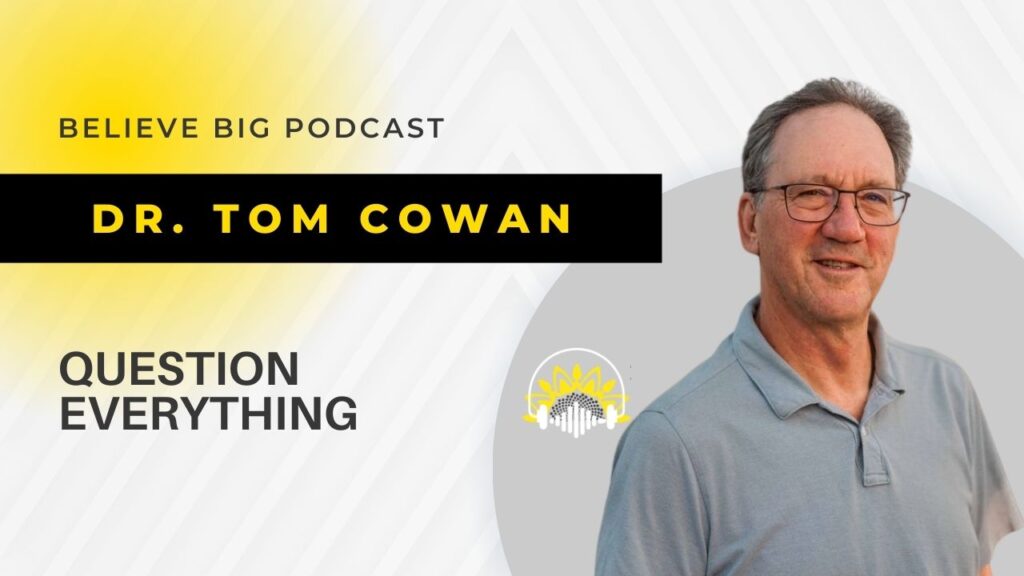
In this thought-provoking episode of the Believe Big Podcast, Ivelisse Page sits down with alternative medicine doctor, author, and speaker Dr. Tom Cowan for a conversation that challenges listeners to think differently about cancer, symptoms, testing, fear, nutrition, and personal responsibility.
Dr. Cowan’s views frequently depart from conventional medical thinking, and some of the ideas discussed in this episode are controversial. But one message runs consistently throughout the conversation: be curious, ask questions, pay attention to your body, and become an active participant in your health journey.
Here are seven ideas from the conversation worth thinking about.
-
Look Beyond the Diagnosis to the Whole Story
Dr. Cowan begins the episode with an unexpected health tip:
Rather than allowing a diagnosis to become the defining story of your health, he encourages people to look at the bigger picture of what has been happening physically, emotionally, environmentally, and relationally.
For someone navigating cancer, a diagnosis can quickly become an identity.
But asking deeper questions may reveal areas where support is needed.
What has changed in your life?
How are you sleeping?
What are you eating?
What stressors are present?
What environmental exposures might matter?
How is your emotional health?
At Believe Big, we continually encourage patients to become informed advocates and look at the whole person, not simply the disease.
-
Ask What Your Body May Be Trying to Communicate
One of the major themes in this episode is Dr. Cowan’s belief that symptoms should not automatically be viewed as enemies.
He encourages listeners to ask:
What is my body trying to accomplish?
He uses examples such as coughing after inhaling an irritant or inflammation around a splinter to illustrate his larger philosophy that some symptoms may represent the body responding to a stressor rather than simply malfunctioning.
His interpretation of cancer goes much further than conventional medical models and should be understood as his perspective rather than established medical consensus.
Still, the larger question can be valuable:
Instead of only asking, “How do I make this symptom disappear?” perhaps we can also ask, “Why might this be happening?”
-
Reduce What Is Adding to Your Body’s Burden
Dr. Cowan uses a memorable analogy throughout the conversation: garbage accumulating inside a house.
In his analogy, the goal is twofold:
Put less garbage in, and get more garbage out.
He connects that philosophy with many practices commonly discussed in integrative health, including:
- Nutrition
- Fasting
- Sauna
- Hyperthermia
- Mistletoe therapy
- Emotional healing
- Reducing environmental exposures
- Changing unhealthy thought patterns
The specifics of any cancer treatment should always be discussed with qualified healthcare professionals, but the broader concept of reducing unnecessary physical and emotional burdens is one many people can apply to everyday wellness.
-
Don’t Ignore the Role of Fear
One of the strongest moments in the conversation comes when Dr. Cowan says:
“Probably the number one toxin we all face is fear.”
Ivelisse expands on this by discussing the effect chronic stress and emotional strain can have on the body.
For anyone facing cancer, fear can become almost constant:
What will the scan show?
Will treatment work?
Will the cancer return?
What happens next?
The goal is not to pretend those concerns don’t exist.
Instead, it is to recognize when fear begins controlling the healing journey.
Practices that support the nervous system, emotional health, faith, supportive relationships, prayer, counseling, movement, rest, and time in nature can all become meaningful pieces of whole-person care.
-
Pay Attention to How You Actually Feel
The conversation becomes especially interesting when Ivelisse shares her own experience with nutrition.
She explains that although she had been encouraged to follow a ketogenic diet, she discovered that a modified approach with additional carbohydrates made her feel better.
Her experience raises an important question:
Should a wellness plan be followed simply because it works for someone else?
Dr. Cowan encourages people to become more observant of their own bodies.
How do you feel after eating a particular way?
Does a certain routine improve your energy?
Does something make you consistently feel worse?
Individualized care matters.
A strategy that helps one person may need to be adapted for another.
-
Use Testing as Information, Without Giving Away Your Agency
Ivelisse and Dr. Cowan have an interesting disagreement around medical testing.
Ivelisse explains that bloodwork helped confirm that changes she made to her diet were producing measurable improvements. For her, the information was empowering.
Dr. Cowan expresses greater skepticism about relying on numbers and argues that people can sometimes surrender too much authority to laboratory results.
The exchange highlights an important tension in integrative medicine.
Testing can provide valuable information, but a number is only one piece of a much larger picture.
Your healthcare team may consider laboratory findings alongside symptoms, imaging, medical history, treatment response, quality of life, and many other factors.
Perhaps the more helpful question is not:
“Should I trust testing or trust my body?”
but:
“How can I use good information while remaining an active participant in my care?”
-
Quality Matters, from Your Food to Your Healthcare
Near the end of the episode, the conversation moves toward something Dr. Cowan believes modern science sometimes struggles to measure: quality.
That includes the quality of:
- Food
- Soil
- Water
- Farming practices
- Ingredients
- Processing
- Healthcare
- Education
- Relationships
Ivelisse points out that even labels such as “organic” do not tell the entire story.
How was the food grown?
What condition was the soil in?
How was it processed?
What happened between the seed and the finished product?
It is a reminder that healthier living does not always come down to finding another number to optimize.
Sometimes it means becoming more intentional about the quality of what we allow into our lives.
The Bigger Takeaway: Stay Curious
You do not have to agree with every idea presented in this episode to benefit from the conversation.
In fact, that may be part of the point.
Dr. Cowan repeatedly encourages listeners to investigate claims rather than automatically accepting them. Ivelisse similarly reminds listeners of the importance of becoming their own advocates and seeking the complete picture rather than relying on headlines alone.
At Believe Big, we believe people facing cancer deserve access to information, support, hope, and conversations that help them make informed decisions alongside their healthcare teams.
Listen to the full episode of the Believe Big Podcast with Dr. Tom Cowan and decide which questions it inspires you to ask about your own health journey.
And if this conversation could encourage someone you love, please share the episode with them.
Important Note
This podcast and article are intended for educational purposes and do not constitute medical advice. Some views expressed by podcast guests may differ from prevailing scientific or medical consensus. Cancer screening, diagnosis, testing, and treatment decisions should be made in consultation with appropriately qualified healthcare professionals.